
The Rise of the Green Party and Its Vision for the Future
In recent years, there has been an increase in interest in the Green Party, with the growing awareness of climate change, environmental degradation, and social inequalities. Traditionally a niche political force working at the grassroots level, the Green Party is now attempting to compete with relation-oriented structures. The Green Party should be expected to gain more influence as sustainability and social justice continue broader social transformations that offer a clear alternative to the so-called mainstream parties. This article is an examination of the rise of the Green Party, its main goals, and its possible impact on UK politics.
From the Green Beginnings in the UK
Dating back to the 1970s, environmental activism finds the place of origin for the Green Party in the UK. It was simply a manifestation of the global movement for environmental protection and sustainability. The party suffered great difficulty finding support initially, mostly considered a fringe party against the established entities, Labour, Conservatives, and the Liberal Democrats.
As climate change gains in urgency, so also has gained attention for the Green Party. In 2000, the party witnessed one of its first glimmers of real political power, and its members were elected to the European Parliament. This success story mirrored the growing acceptance of green politics in the UK, especially by the younger ones, who were increasingly anxious about the environment.
Founding Policies of the Green Party
Because sustainability, social justice, and equality are dear to it, the Green Party believes that its policies should embody that. Their platform extends to practically every issue out there, ranging from climate change and environmental protection to income inequality and the public services. Some of the key policy goals include:

Climate Change and Environmental Protection
Another huge objective of the Green Party is to stop climate change. The party is pushing for high targets to reduce greenhouse gas emissions, so that the UK gets on track towards net zero emissions in the economy.

Green New Deal
Profits generated in social investment in a Green New Deal would exacerbate the situation of social inequality. The concept of deficit spending in Green New Deal presupposes huge resource allocations for the energy sector, development of sustainable public transport and discouragement of excessive heat gain in buildings. The Green New Deal is considered to be supportive to the process of rebuilding nations in a way that is environmentally friendly and promotes fairness, notably in those our nation has the experience of severe industrial decay and economic decline in huge areas.

Social Justice and Equality
Social justice demands have been at the core of the Green Parties’ philosophy. It stands for initiating programs to reduce social disparity and protect workers’ rights while guaranteeing good healthcare and schools for everybody. The party has presented the concern of wealth disparity as something quite important practically. One solution proposed has been for a Universal Basic Income to ensure that wealth is shared in the same fashion.

A Fairer Economy
An economy that is just and equitable, as the Green Party upholds. It considers the economic system as an institution that gives away too much to the affluent while worsening social inequality. The Green Party supports progressive taxation, fair living wages, and the range of programs that alleviate poverty and unemployment.
Internal Party Structure and Leadership
The Green Party’s leadership system is very different from the ones more prominent than it in the UK. It coalesces two co-leaders, shared responsibility, and gender balance at the top. Such a preference for decentralisation is very consistent with the ideology of the party that further empowers increased democratic participation. Fundamentally, it is through leadership that the party was able to increase its national importance, especially through figures like Caroline Lucas, who became the party’s first MP in 2010. Disparate experiences have, however, meant irregular media visibility; this irregularity has been rescued by strong leadership and consistent messaging that have been able to retain the green identity as a values-based party with clear priorities for environmental and social reform.
The Green Party’s Influence in UK Politics
Though not yet having governed in the UK, the party’s strength is steadily increasing. It has achieved council seats in local elections, mostly in urban areas where environmental issues are of top priority for voters. The 2019 European Parliament elections provided further evidence of the rise of its political profile, with the party winning an unprecedented number of MEPs.
The party has success on the national level, having pushed the Central-Level Agendas of climate change, sustainability, and environment. Ingesting pressure for environmentalism, other political parties had to make climate change an issue in their own platforms because of Green’s push.
However, the party finds it hard to pierce the cords of the two-party system. Their policies might have widespread attention from the young and environmental activists, but it is at a loss there for wider acknowledgment in rural and aged demographics. Another continuing challenge confronting the Green Party is how to take its policies and shape them into a concrete, successful issue suitable for wide electoral acceptance.
Green Politics and Public Engagement
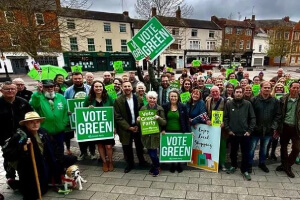
Another important element leading to the rise of the Green Party is the party’s interaction with the public, especially at the grassroots level in campaigning and activism. The party has exploited social media to reach out to voters and gather support for bringing environmental issues to the limelight. The Green Party also joins broad-sector environmental movements for concerted action with NGOs and advocacy groups to press for stronger environmental protection.
Another populist feature that cuts across race, gender, and sexual orientation has, in turn, attracted many disenfranchised voters clamoring for gender equality, racial justice, and LGBTQ+ rights. Through its positioning of itself as a modern political force in the UK, the Green Party is attracting people who feel neglected by traditional political parties.
Youth Support and Political Education
Climate change and social justice are main political issues for many young voters that give Green Party strong support. University campuses, climate strikes, and online spaces serve as perfect recruiting grounds for youthful members and activists. It has also been keen to ensure political education toward civic awareness and longer-term engagement beyond just a bunch of electoral wins. This will definitely impact British politics in the future as this generation of younger voters is going to outnumber the older boys. Green success thus turns on whether they can channel that youthful energy into measurable electoral clout.
Challenges Ahead for the Green Party
There are several major stumbling blocks for the Green Party as it grows in support. One is the capacity to evolve from a single-issue party courting environmentalism into a much fuller political force capable of competing for power on the national level. Environmental policies form the core set of policies for the party, but there may well be other things voters want more of in the general election rather than just climate action.
Another is the issue of proportional representation. The UK electoral system tries to first-past-the-post favors its larger parties at the expense of smaller parties, like the Green Party, that merely wish to exist. This has led to much clamor for electoral reform so that smaller parties may have an influence on national politics.
Lastly, the party will be faced with the necessity of balancing idealism with practicality. Even if the aspirations are great, sometimes their realization is met with opposition by the most conservative of elements that make up the British political system today. Demonstrating that the party can effect the fulfillment of its aims without disrupting the economy or society at large will be a challenge.
The Future of the Green Party in the UK
The Green Party faces an uncertain yet genuinely promising future within the UK political landscape. The increasing swelling on climate change and environmental sustainability, with a tide of public support towards progressive social policies, means that maybe, in the future, the Green Party together can write a chapter relating to the UK politics. The Green Party’s ideas of equity, sustainability, and social justice could be the fresh impetus many voters are looking for, as more of them turn away from conventional party politics.
Summary
The Green Party in the UK, until recently, was a series of localised pockets; it is now a growing major political actor in the spectrum with much influence. Though it continues to face difficulties in securing electoral success and broadening appeal, the threats posed by climate change, social justice, and the creation of a fair economy, attract growing numbers of voters worldwide. With climate change, inequality, and sustainable development taking centre stage in present-day Britain, the Greens would surely have a say in discussion for years ahead.